01
Receptor binding
The peptide has to reach the right receptor and hold on long enough to matter — and ignore every receptor that looks almost the same.
Pedram Yousfi researches how short chains of amino acids find their receptor, change its shape, and turn that single moment of contact into a measurable effect in a patient. This site collects that work — and explains it in language a clinician, a researcher or a curious reader can use.
Below is oxytocin: nine residues, one disulfide bridge, and an effect strong enough to be used in hospitals every day. Select any residue to see what it contributes.
Forms the disulfide bridge with residue 6 — the bond that closes oxytocin into a ring and holds its shape.
POSITION 1The peptide has to reach the right receptor and hold on long enough to matter — and ignore every receptor that looks almost the same.
Binding changes the receptor's shape. That change is passed inward through G proteins, kinases and second messengers.
The cell answers: a channel opens, a gene switches on, a muscle contracts. Multiply that across a tissue and you have a response.
Dose, route, half-life, safety margin. This is where the molecule stops being chemistry and starts being medicine.
Why one peptide activates its target and leaves a near-identical receptor untouched. Affinity, kinetics, and the side chains that decide both.
Peptides are fragile by nature. Cyclisation, amidation, unnatural residues and carrier systems are how a promising molecule survives long enough to work.
Tracing what happens after binding — and where a therapeutic effect separates from a side effect.
Purity, impurities, immunogenicity and the regulatory expectations that separate a real product from a claim.
Sorting published peptide research into what is established, what is early, and what is marketing.

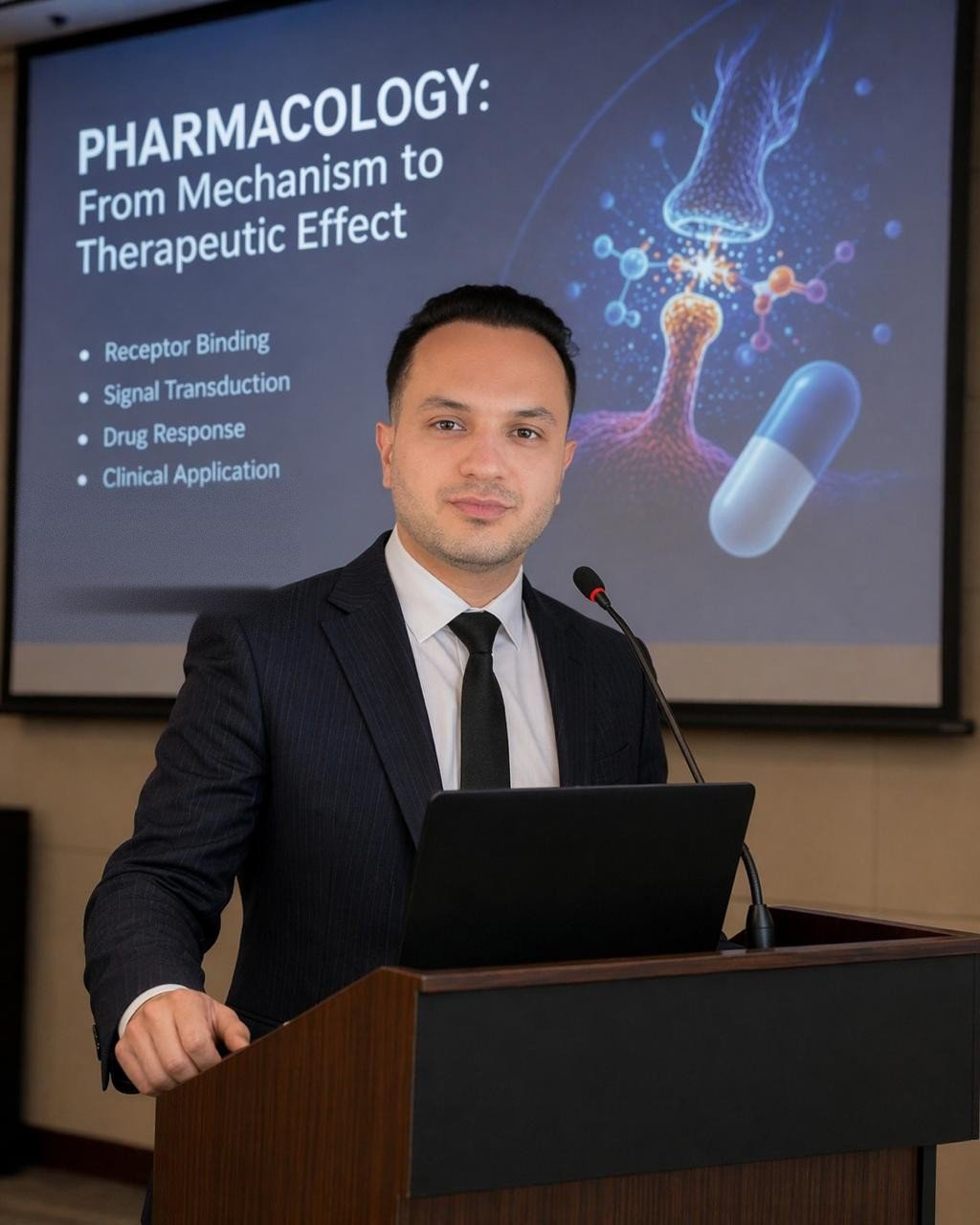
Lectures and workshops for pharmacy students, clinical teams and industry audiences — in English and Arabic, built around the same idea: if you can follow the molecule, you can judge the claim.
Pedram Yousfi is a doctor of pharmacy whose doctoral work centred on peptides — how they are built, how quickly they disappear, and what has to be true for them to reach a receptor intact.
The work sits between the bench and the clinic. On one side, structure, stability and binding data. On the other, the practical questions that arrive from clinicians and patients: does this actually do anything, is it safe, and how would we know.
A scientific consultation is a focused session — usually 30 to 45 minutes — for people who need a clear read on a peptide, a mechanism or a study.
This is scientific and educational consultation. It is not a diagnosis, a prescription, or a substitute for care from your own treating physician.
Opens WhatsApp with your message ready to send. Replies usually within one working day.